As promised in my last post, here are a few games I recommend to see good use of Minor Narrative Interaction. Some are obvious, and some less so. These games make good use of interactivity without making the entire story hinge on the interactive elements and the player's input, and they do a very good job of increasing emotional impact and character empathy through these techniques (though for the sake of spoilers, I won't describe exactly how). There are more that belong on this list, of course, but these are some particularly good examples. If you feel there is another game that should have been included, feel free to say why in the comments!
Bioshock
If you're interested in games as a narrative art enough to be reading this blog in the first place, you probably know what I'm talking about. Bioshock has not only a fantastic twist in the story, but it presents said twist in a unique way that not only emotionally involves the player through excellent use of minor narrative interaction, but hammers the point home like a railway spike straight to your intellect. A truly brilliant moment in a truly brilliant game that must be experienced.
Beyond Good and Evil
The final boss fight of this game is one of the best examples I've seen of symbolism in actual gameplay. The controls during the final battle very accurately reflect the struggles of the protagonist and her state of mind at the time in a rather brilliant way. It's rare to see a game play with the controls to give meaning to even the game's basic control scheme.
Final Fantasy X
I mentioned this in the actual article. Final Fantasy has a bit of a reputation among some for not involving interactivity at all, for just being long stretches of gameplay punctuated by cutscenes. For one, that's not true. Secondly, there's no reason those stretches of gameplay can't be great examples of minor narrative interaction. This game takes a normal gameplay sequence and, through emotional music and the weight of responsibility on the player, makes the entire process a battle within you between the desire to leave and the need, from both the game and the story, to continue on.
Shadow of the Colossus
The death of a colossus in this game is not a triumphant or exciting experience. The battle is epic and exhilarating but once you have killed them, the magnificent beast falls to the ground, life pouring from it, as tragically beautiful music plays. It's a beautiful moment that evokes more sorrow than triumph. Seems kind of weird, seeing as killing these colossi are the key to reviving your dead loved one. But it will all make sense in the emotional ending, in which your efforts certainly make the scene more impacting than yelling at an onscreen character ever could.

Showing posts with label games. Show all posts
Showing posts with label games. Show all posts
Wednesday, August 17, 2011


Saturday, April 16, 2011
The Narrative/Gameplay Paradigm: Why Games Depend on Violence

There is a phenomenon in game design that demands the presence of violence (as a specific type of conflict) in the stories of video games. Though this principle is not universal, and can be overcome, it is powerful, and the overwhelming majority of video games conform to it. This principle is the Narrative/Gameplay Paradigm. This, at its heart, is the fundamental problem of the juxtaposition of gameplay and narrative.
 Were I to sum this principle up in one sentence, it would be as such: A game’s structure must be known to the player, whereas the story’s structure should not. Hopefully this somewhat cryptic idea will make more sense by the end of this article.
First, though I am not going to launch into a lesson on story structure, I am going to emphasize one thing about it. Though stories are structured, and most good stories share many structural similarities (even all, if you strip them down to their most basic forms), the way that structure plays out should never be known to the viewer/player/reader (excluding, of course, adaptations of known stories or historical events). Though we usually know how a movie begins based on a trailer, we should not know how it ends. Though we know that the end of the movie will feature either the success or failure of the protagonist’s quest, we should not know which and what it will mean to the story’s characters and world afterwards. Stories are structured, yes, but the one experiencing the story should not have full understanding of a given story’s structure until it has ended.
However, games, by nature, are not like this. A game, be it a video game, board game, sport, whatever, requires the player to know their goal and the ways they can accomplish it. Even games like the classic point-and-click adventure games, in which much time is spent trying to figure out what the player has to do, the structure is constantly present. The controls are the rules, the tools by which the player completes his/her goals. Completion of the goal is success, whereas failure is to lose the game, and the criteria for either outcome are part of the rules. Even if the goals are unclear, the game’s rules, its structure, must be understood by the player. The game cannot be played otherwise.
You may already be seeing the paradox that is forming between the two. The combination of a game, which must be understood in order to be played, and a narrative, which must involve mystery in order to have full effect, can cause issues. Namely, if you know that victory in the game equals victory in the story, there is no surprise in the narrative, but how can one know they are making a victory-oriented decision in a game if the mystery of the story is preserved? Both narrative and game need conflict, but how can both play out when the structural difference is so great?
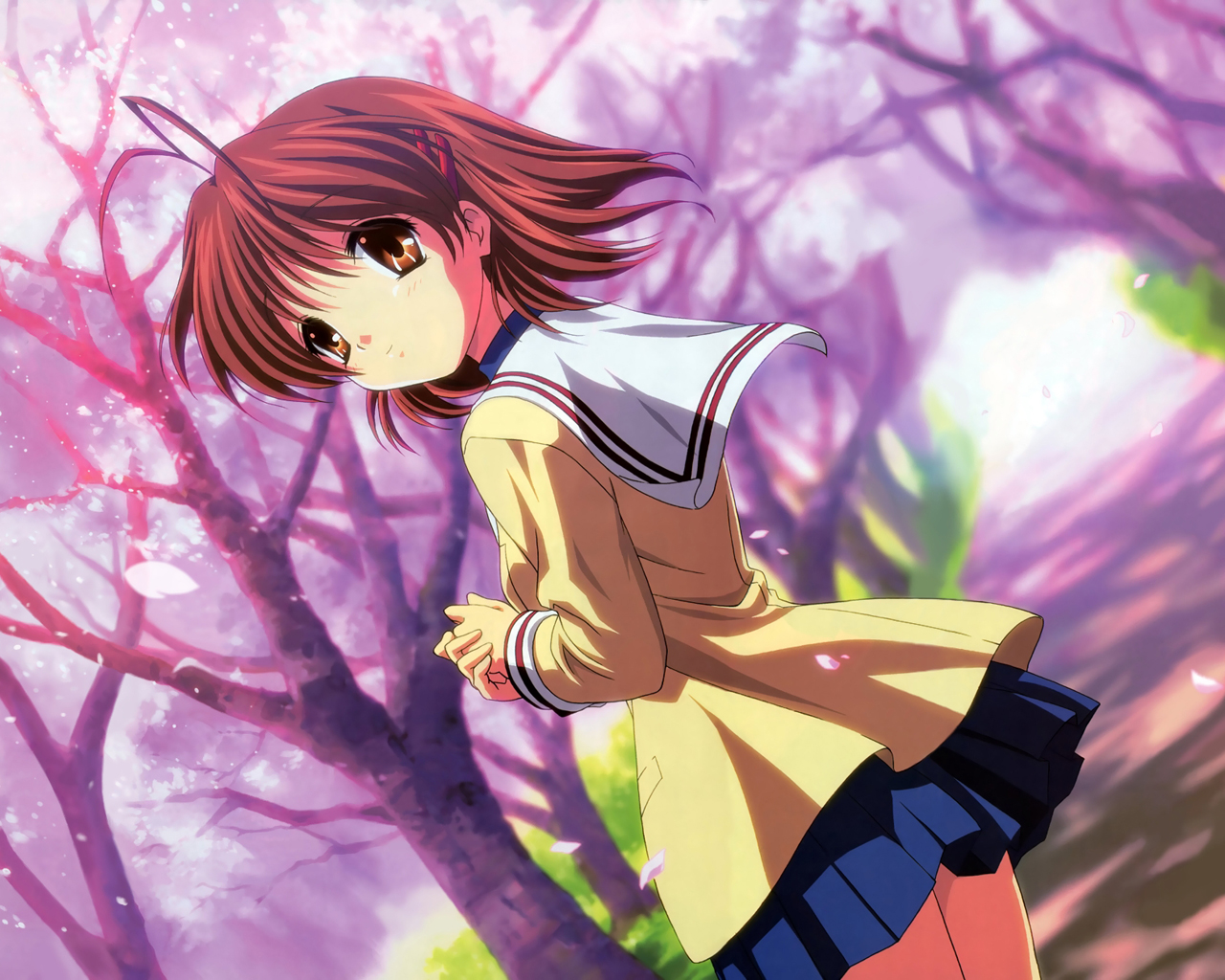 |
| Sometimes it's hard to tell what the best choice is in Clannad's  emotional romance story. |
However, the opposite is true as well. If story attempts to wholly dictate gameplay, how can a game possibly emulate the amount of choices and abilities that would be available in real life? It is a technological and creative impossibility. There is a reason the player cannot roundhouse kick an enemy in the face in Halo
 ; it would be fully possible for the Master Chief as a character, but including every action he could perform in the gameplay mechanics simply would not be possible, least of all practical (thus leading to the whole, "That cutscene was awesome; why can't I do that in the game?" issue that plagues so many action games). For that matter, if you’ve played Phoenix Wright
 , you know how frustrating it can be to work out a solution and find out you were mistaken, not because your conclusion was wrong, but because it’s not the specific solution the developers programmed into the game. This is inevitable; it is impossible for a game to include every response Phoenix could have, or even every logical path he could follow to a solution.
In this way, gameplay and narrative are inherently at odds. How does one provide the player with a clearly rule-based game while also presenting a narrative not driven by these rules, but by a workable plot and natural characters? It is a difficult question that few developers have even dared to stare in the face, which leads to the most important function of the Narrative/Gameplay Paradigm.
Take a look at your game library, or at least think through the games you own for a second. Consider how many games you have that are not centered around a life/death conflict. If you have mostly adventure games or visual novels, you're in a minority; think about the majority of games as a whole. The vast majority of narrative games are like this; one obviously thinks first of violent games like Grand Theft Auto
 or God of War
 , but even Pac-Man and Asteroids are defined by a life-or-death struggle. Have you ever wondered why this is?
The Narrative/Gameplay Paradigm gives us this answer (though it’s hardly considered anymore since violence has become the base model for most games); death is the only thing in life that can really be considered an absolute form of defeat. Guy doesn’t get the girl; maybe he can win her back, or maybe there’s another girl. Detective doesn’t find the evidence he needs; there will be more opportunities, more crime scenes. But death is the end. Unless a game's story goes into the afterlife or something, death is the end. No questions asked. If the player character(s) die, that is the end. There is nothing left.
 What better way to work around the Narrative/Gameplay Paradigm than this? Consider Halo: if Master Chief dies, the player fails and has to try again. If he lives to advance through the story to the eventual end, he wins. Survival is success, death is failure, and there is no reason to question either. The same works for Mario
 , Prince of Persia
 , even older games like Missile Command. The struggle between life and death is the easiest thing to portray in an interactive context, because it provides a straightforward framework for victory and defeat.
The resulting problem is that video games mostly tell stories that could best be compared to action films. There is nothing wrong with that kind of story: as it is, video games have told plenty of stories that, in my opinion, belong among the best works of classic literature and great film. But video games can only evolve so much as a medium when genres such as romance, domestic drama, and mystery are as overlooked as they are.
There are many ways to overcome this paradigm. Far too many for me to cover here, else you’d still be reading this article an hour from now (or, more likely, you'll have stopped a good deal before then). I’ll cover them later, either in their own articles or mentioning them in other contexts, whatever works best for them. Until then, feel free to comment with your thoughts on this concept! This is one of the original ideas I’ve had, and I’ve been developing it for a while, so feel free to criticize and help me develop it further in your comments or emails! If you think this stuff is interesting, please consider liking Binary Narrative on Facebook.
Saturday, April 2, 2011
The Importance of Video Games as Art

I was trying to figure out how I could start this off, and I think this is a good topic to cover early on. Hopefully this first post can address some of the basic questions and criticisms people might give early on. I can’t possibly address everything, so if enough people make comments I may very well write another post on this subject, but for now I’ll address this as I can.
Now and again in various internet forums someone will post something regarding video games as art, and many views on the subject start flying. There are often some interesting things said within this sea of mostly repetitive arguments, but there is one simple thing I keep hearing that has been getting to me for a long time: “It doesn’t matter.”
 Most gamers argue that video games should be looked upon more favorably by society, but many of them do not feel as strongly that society should look upon games as an art form. The ideas behind this viewpoint are varied. Some claim that as long as they can enjoy their games, it doesn’t matter whether or not they are an art form. Some say as long as gamers know and understand games as an art form, society as a whole does not need to. Yet others claim that the very meaning of “art” is subjective, meaning that video games are art if you think they are, and they are not if you think they’re not, so the entire issue is meaningless. All of these arguments are based on some degree of subjectivism, but regardless of whether that fits into your personal philosophy, there is something very important that they all ignore.
If you’re not one for art theory, think back to your high school or college sociology class and what it said about art. In short, art is an absolutely vital, critically important part of culture. Art is the way humans try to explain and explore some of the less quantifiable aspects of the human experience. It’s the way we both influence and record our culture of the time. Creativity, the driving force of art, is one of the things that separate us from animals. Art brings culture together, defines and enforces societal values, and has the power to affect both individuals and culture as a whole.
 |
| 'Cause these two are totally the same, right? |
 Since art is so important to culture, it makes sense that the concept of art must be solidified enough to study it. In fact, this is already done in many ways that we often take for granted; consider genres, for instance. Despite the complexity of art and all the ways it can be presented, in order to more effectively study artworks, we have assigned them labels based on their themes and settings even though these things are much too difficult to grasp with a system of simple labels. What chaos would ensue if we tried to study Citizen Kane
 in the same way we study District 9
 , or if we applied the same analytical logic to Sense and Sensibility
 as to Lord of the Rings
 ! However, there are always the occasional works that challenge these genres, often resulting in new genre labels until there are so many sub-genres that most people can’t figure it out. How do you categorize Apocalyptica
 , a hard rock band comprised of four cellists and a drummer (no, I’m not kidding; check them out)? Has anyone yet put Shawn of the Dead
 in a definitive genre, or does it still stand alone in the “romantic zombie comedy” category with a healthy dose of parody thrown in? Genres are important because they allow us to more effectively study artworks, but they are ultimately an attempt to quantify the unquantifiable. Impossible though it may seem, it is very important.
So considering the importance of putting a definition on the indefinable, one must ask what bearing a subjective art theory has on this. The answer? Nothing at all. Because even if the very definition of art is up to the individual, that is not an effective way to study or categorize something. Such ambiguity has its place, but this, a situation where something must be categorized and studied, is not it. We as a culture must attempt, as best we can, to solidify these slippery concepts of art and creativity so that we may analyze them, explore them, and allow them to affect culture as they can and must.
This is why, regardless of whether “art” is a subjective or objective concept, definitions regarding what general medium is and is not an “art form” must be made if a culture is to effectively study, explore, and truly experience what art has to offer.
This is my view on the issue, at least. If you have any questions, disagreements, encouragements, suggestions, whatever, feel free to comment. And if you like what I’ve said so far, like me on Facebook! Or if not, just wait to see if I ever say anything good first.
Subscribe to:
Posts (Atom)