Wednesday, June 29, 2011

In Addition to This Week's Article

There's another thing I thought of after writing the article about comparing film to video games.  That is, why do we treat the medium different than it's genres on this matter?

In genres, bending and combining is encouraged and praised.  RPG elements such as leveling and skill trees have been incorporated into even the most mindless of genres, and though it's perhaps gotten a little commonplace, I can't think of anyone who actually condemns that trend.  When Mirror's Edge mixed platforming with the first-person perspective, even people who disliked the game for its very imperfect nature agreed that it was inventive and interesting in its concept (I recommend it highly).  When a movie mixes genres, such as Shawn of the Dead (for a rather extreme example), it gets highly praised.  So why is it when we try to mix mediums, this is doing video games a disservice?

I think part of it may sprout from the recent mainstream nature of interactive media.  All of us who are really dedicated to gaming and have been since before it was cool get kind of threatened now and again by the encroachment of "casual gamers" on our territory, and perhaps this is one of our ways of trying to keep our medium separate, out of reach of those who would dare defile it with ideas from outside the gamer's realm.

Okay, so that's a bit overdramatic and exaggerated, but the point stands.  But I think it may play a part in why we sometimes try to segregate our medium away from the influence of others.  Maybe the integration is bringing us too close to being normal, no longer being able to wear the "gamer" badge as an honor since everyone will be wearing one in the near future.  But the artistic and cultural development of this medium is more important than that.

On another note, I finally got around to playing Castlevania: Lords of Shadow.  I'm usually pretty good at keeping my love for a franchise out of the way of an adaptation of it (which this essentially is, seeing as it's made by a different developer and trying, yet again, to convert the series into 3D), but I just can't with this one.  It's a pretty good game on the whole; passable if typical hack-n-slash gameplay predictably reminiscent of God of War, a conflicted and mysterious protagonist the player can connect with easily, beautiful scenery that draws you into this finely-crafted world... it's all there for a decent if slightly generic action game.  But so much of it is not a Castlevania game.  There's not yet been a single mention of Dracula, for one, but mainly, the game is almost entirely linear.  Almost Final Fantasy XIII linear.  No big castles to explore, no huge side-areas just to get one powerful item, just straight pathways with the occasional offshoot or fork in the road.  There are some areas you must return to later with another ability to get by something, but it's done in chapters and levels, not a single continuous game world.  As I said, I can usually handle change in situations like this, but this just doesn't feel like a Castlevania game, and it's affecting my enjoyment of it way more than I wish it would.  Somewhere in here is a decent and rather beautiful game, but it's tough to go through it wishing it was something else entirely.

Don't think the Supreme Court decision escaped my notice; full article about it next week!

Saturday, June 25, 2011

The Comparison to Film


Film and interactive media have an interesting relationship.  Film has often been a reference point for video games as they have developed as a medium, both in understanding and inspiration.  But this is a different medium, one that is still coming into its own and learning to use its unique capabilities: capabilities film, and any other medium, simply do not have.  So what place does film have in understanding video games?

"Cinematic" qualities in games became more valued as hardware developed to allow more visual style in cutscenes and gameplay.  Now that games are coming into their own, however, this comparison is being viewed very negatively, saying games should not constrain themselves by basing this interactive medium on an older, non-interactive one.

We all know what happens to
things with bad foundations...
I do not disagree with that last point.  It's been endorsed by game critics from Yahtzee to Jim Sterling to tons of random vloggers on Youtube, and it definitely has validity.  It makes sense that we would not want the foundation of a new medium, especially one as unique as this, to be based on the development of an older medium that entirely lacks this new medium's defining quality (in this case, interactivity). That said, I think it's important that we not discard the benefits that can be had by studying the two side-by-side.

On a simple level, the comparison is useful in preliminary understandings of how video games tell their stories because, while film and interactive media are definitely not the same thing (main difference being interactivity, of course), they are closer to each other than any other storytelling mediums.  If you tried to explain to someone who had never played games since the Atari that video games are a narrative art now, they would likely have a tough time understanding it.  If you tried explaining it entirely from scratch, as though they know nothing about how they work, it would be difficult to give them a good understanding because they have no frame of reference.  But say, "It's like a movie, but you're part of it," and it instantly makes sense.  It's hardly comprehensive, and someone who's really interested would still have plenty of questions to ask, but by referencing something similar of which they have a clear understanding, the concept is much easier to understand.

I know I wasn't the only one
that loved this game, but enjoyed
watching it almost as much.
As for applications to gaming beyond that basic level, as much as the idea of "cinematic" gaming is scoffed at sometimes now that it's commonplace, we owe a lot to it for making our games more visually interesting. There was once a time when cutscenes were valued because they simply looked cooler than gameplay; that time has passed, and the idea of cinematic style is largely to thank for that.  Creative in-game camera work and more flair in character movement has made some games almost as much fun to watch as they are to play, from Prince of Persia: The Sands of Time to the Uncharted series.  The early effects of games trying to be "cinematic" are largely responsible for the visual style that we now take for granted.

When it comes down to it, all we are doing when comparing video games to film is trying to learn from another medium.  It happens regularly in all other artistic fields, and hopefully it will continue to happen.  Other mediums, with their strengths, weaknesses, and unique abilities, have a lot to offer one who studies them for application in another medium.  Closing yourself off from other mediums to exclusively study one cuts you off from a lot of great influence and out-of-the-box ideas, and can cause a developing medium to become stagnant and monolithic.

But I think we can generally agree that just because an artistic medium is different does not mean it doesn't have something to offer other mediums, and maybe even that there is value in learning from more established and developed mediums.  But when does this concept go too far?  The common answer I've seen when it comes to this issue is, "When the game is trying harder to be a movie than it is to be a game."

The commonly-cited example as of late is Heavy Rain, a game that is essentially a movie that lets you determine the events through story choices and quicktime events.  And here I use the term "game" for lack of a more fitting word; many have argued that Heavy Rain is not actually a game, something I might agree with if not for the fact that these arguments usually paint that fact as a bad thing.

I'll just admit it right now: I loved this game.

The express goal of Heavy Rain was to be an interactive movie; thus, the criticism.  I believe the term coined by David Cage, director of the project, is "interactive drama."  It was not simply adopting cinematic principles into a game, it was basing the presentation of the game entirely around them, with gameplay reduced to generalized button presses related to the action onscreen.  The negative reaction many gamers had to this was that Heavy Rain was trying to be a movie instead of a game, and since games are their own thing and shouldn't define themselves based on older and simpler mediums, this was a bad thing.

It should be noted, however, that despite Heavy Rain's simplified gameplay, it took more full advantage of player choice and story consequences than all but a few games I've ever played.  Most other games that could be dubbed "interactive movies" are similar in nature; in the relatively few examples of this within the medium, interactivity is never abandoned.  Perhaps gameplay is, to some extent, but the storytelling is more dependent on interactivity than the vast majority of shooters or action titles.  The uniqueness of video games is still heavily present, just not in the same way as your average game.

I don't mean for this article to turn into a defense of Heavy Rain, but I do want to use the game as an example to make a point.  If all games started being like Heavy Rain, focusing on being as much like a movie as possible, we would have a problem.  But if all games started doing any one thing at all, we would have the same problem.  Innovation and experimentation is always inspired by something, and in the case of some games, that something is film.  In others it's poetry.  In others it's music.  And in others it's simply cool ways to make some guy's head asplode.

Bulletstorm's skill kills are probably the best recent
example of that latter inspiration.

My point is simply that there are many things that can inspire one to create art. That art may take on characteristics of many things, and this experimentation and blending is important to the artistic exploration of all art forms, genres, and mediums involved.  Should we base all our interactive art theory on another medium like film? Absolutely not.  But that definitely does not mean we should condemn the games that try to blend the two mediums.

Wednesday, June 22, 2011

Didn't See That Coming...


So apparently video games are actually decreasing violence in the United States.

Fact is, anyone who is actually familiar with video games and has been watching crime rates over the last decade or so already noticed the correlation.  Obviously that is not cause to assume causation, but it certainly seemed interesting, especially in the face of claims that video games were responsible for the rise in youth crime.  The rise that, based on even a simple glance at the figures over the last 20 years, has never existed during the life of this medium.

So I say it's about time someone figured it out by doing a legitimate study.  I especially love that it's not actually a study on video games, it's a study on the crime rate decrease; it has nothing to prove regarding video games, it just caught on.  Just an exciting bit of information; the decreasing crime rate has always been an argument against video games causing violence, but now it's actually a real argument for societal value, not just lack of damage.

Saturday, June 18, 2011

Pretium Vita

I've been working on the article I meant to put up this week, but it's just not forming up as well as I would like.  It's an important issue and I want to do it justice, and for some reason my writing lately has felt kind of like that last paper you need to write at 4:00 AM the night before your final is due.  As a result, I decided I'd rather deliver a good article to you later than try and pump out something mediocre, especially on the topic I've been writing about.  You'll find out what it is next week, in an article that will hopefully do justice to the topic.

So I'll use the placeholder I've had prepared for just this situation, if you'll excuse a bit of advertising myself.  Last year my university had its annual film festival, where the 10 best of the submitted 10-minute films were shown at a ceremony and awarded in various categories based on the judges' decisions.  I decided to make a film for it.  For the sake of being different (and because I'd messed with it before and really enjoyed it), I made a machinima using Halo: Reach.  Most entries were live action, of course, but this festival had seen a few alternative types of films, including stop-motion and animation.  Machinima, however, had never been done before, and I wanted to see how well it was received.  So, I made Pretium Vita.


In the end, it did not win any awards, though Jessica Nelson was nominated as best supporting actress for her role as Rachel.  One of the judges came to me later and explained that, being unfamiliar with machinima, the judges were unaware as to how much effort had gone into the film on my part, and did not award it anything because they thought the program did most of the work.  But it was a good experience, and I think the final product turned out well.

Sorry you didn't get the usual article, but I hope you enjoy the film.  Next week I'll be back to normal.

Wednesday, June 15, 2011

E3: The Unknowns

Since most of what I covered in last week's E3 post was the bigger titles, I figured I should shine the light on some of the smaller or newer titles that caught my eye.  These are ones to keep an eye on. Careful, this is another Youtube-heavy post.

Bastion: This game seems to be an interesting action RPG.  I haven't seen enough to talk too much about it, but the basic concept is that as you go through the levels your actions are narrated.  It sounds annoying, but the way it is used it actually seems really interesting.  The narration either puts the player's actions in the context of the story or involves gameplay hints, such as implying whether it's wise to walk in the place you just went.  The gameplay seems to be pretty creative as well; nothing groundbreaking, but it doesn't look like you'll be facing the same simple enemies over and over again.


Metro: Last Light: If you haven't played Metro 2033, go do that right this second.  It was a really awesome post-apocalyptic shooter with some awesome survival mechanics and great atmosphere.  Rather terrifying, not necessarily because it was that scary, but that atmosphere just made it wonderfully immersive.  For that matter, it is one of the few, if not the only, example of a great game based on a novel.  It is not to be missed, and I really hope this sequel lives up.


Jurassic Park: Developed by adventure game veteran designer Telltale Games, this looks to be an interesting expansion on the story of the classic dinosaur film.  Though most of their adventure games follow a traditional point-and-click control scheme, this one looks to be taking a cue from Heavy Rain in how it functions.  The result definitely looks interesting, and I look forward to seeing how it turns out.


Trenched: A tower defense game where you also do some actual shooting on the battlefield?  Count me in.  This summer-bound game is developed by Double Fine, the studio founded by Tim Schaefer (Psychonauts, Brutal Legend).  The idea is interesting, and the style seems like the wacky, awesomely strangeness you would expect from that studio.  Speaking of Double Fine...


Once Upon a Monster: This is less a recommendation to check out a game as it is an interesting note on one.  This is a Sesame Street game being developed by Double Fine, and it was at E3.  It will be a storybook-style game aimed at teaching kids basic lessons and values, much like the show.  I imagine it will be far too simply for adult gamers to enjoy, but my interest comes from the fact that a kids' game was at E3 in the first place, and is being done by a respected developer.  I hope it's indicative of an end to the far-too-common "kids don't know a good game anyway" approach to kid-oriented game design.


Prey 2: Prey was an interesting little shooter in the early days of the Xbox 360.  It was by no means perfect, but it was very interesting and had some pretty awesome concepts that some consider to be the simplified precursor to the Portal gun.  The sequel doesn't seem to be directly connected, but I'm excited that a game that showed such potential is getting a second go when we have a better hold on the technology.


Defiance: This is interesting.  This is an MMO tie-in to an upcoming show on the Sy-Fy Channel; apparently the idea is that the events in the game and the events in the show will connect, and what the players do in the game will affect some events in the show.  The concept is really intriguing, and while it's yet to see whether the game is going to be any good, it's an awesome experiment for which I am rather excited.


Rounding out this list are two games with weird names; the first is Awesomenauts.  Awesomenauts looks to be a just-for-fun side-scrolling shooter with an art style similar to games like Castle Crashers.  We'll see if it's any good, but seriously, it's called Awesomenauts.  That has to be at least worth checking out.  And doesn't this music just sound like some Saturday morning commercial from the 90s?  Awesome.


Secondly, there is Insanely Twisted Shadow Planet.  This one looks quite interesting, with an intriguing aesthetic and some awesome-looking side-scrolling puzzle/action/shooter/platforming(?) gameplay.  I think this'll be one to keep an eye on.


Anyway, there are a bunch of games from E3 that maybe didn't quite make it onto your radar.  I hope you give some of them a look; they deserve it.

Seriously though, where the heck was Beyond Good and Evil 2?  Ubisoft, you continue to make me cry...

Saturday, June 11, 2011

Entertainment vs. Art: How Do They Relate?


In the interest of argument, I'll sometimes go onto a random chat site (just text, not video chat; I want information and discussion, not mental scars) to ask people if they think video games are art.  I've gotten all sorts of replies, but a surprisingly common one is that they are not art, but entertainment.  Which is interesting to me, not as a sort of argument against games as art, but as a general principle of art theory.

The question here is one of coexistence.  Can art be entertainment?  Can entertainment be art?  Are both capable of being the other, is one inherently also the other, or are they entirely separate, with no overlap?

Tag, you're it!
Well, there are definitely things that are entertaining, but are not art, at least in its culturally defined sense.  The best example is that of children.  Kids are entertained by the simplest of things; they don't need a complex RPG battle system or a non-stop action-packed movie, they just need you to grab onto their hands and spin them around.  To a child, pretty much anything is entertainment.  A game like Tag is obviously entertainment, but it would be difficult to argue for its status as art.  So entertainment can most definitely exist independently of art.

But is absence of art a necessary quality of entertainment?  I think a simple glance at any art form will prove otherwise.  Film is an art form, and movies are enjoyed by millions of people on a daily basis, most of them not even giving a second thought to its artistic value as long as they were entertained.  Literature does this as well, as do visual art forms such as painting and photography; just because something is an art form does not mean it can't be entertaining.  In fact, most art forms in today's world are dependent on some form of entertainment since artworks need to make enough money to fund others.

Thus, we conclude that entertainment is capable of being entirely independent of art, but is also fully capable of, and commonly does, exist within art.  In short, it can go both ways.  So now that we know how entertainment relates to art, how does it work the other way around?

Art can, I suppose, exist independently of entertainment, though that possibility is heading squarely into subjective territory.  I've known people who couldn't stay awake through the original Star Wars films because they were bored to death.  I've since avoided those people like the plague and now pray for their salvation on a daily basis.  Point being, these are three films largely considered some of the best, most influential and important works of cinema in history, and some people find no entertainment value in them.  Entertainment is a rather subjective thing, up to personal taste, so the only way we could make any sort of concrete judgement in this specific area is by considering intent rather than effect, since the effect of entertainment tends to be subjective.  So for the sake of figuring out art's relation to entertainment, I will use the word "entertainment" not to refer to anything that is entertaining to someone, but rather to anything that is created in order to entertain.

Case in point: I highly doubt you
watched Schindler's List thinking,
"This is so fun!"  But it was great.
But is there any art that does not seek to entertain in some way?  Sure, art has a higher purpose than to simply entertain, but if the viewer, reader, or player is not entertained, how will they be interested enough in that message for it to really have an impact?  The viewer/reader/player must be invested in the artwork, and that is best accomplished by being entertaining in some way.  Perhaps not "haha, this is fun" sort of way, but I think we can all agree based on the existence of horror movies, intense action games, and pretty much any other media made to keep those experiencing it tense, that "having fun" is not necessarily the same as "being entertained."  It would seem that art seeks to entertain as a means of communicating the higher purposes of its existence.  Perhaps this does not mean that entertainment is always necessary to art, but it most definitely points to the idea that entertainment is an important aspect of art, not some sort of opposing force to it or a "lower" version of it.

We have determined that entertainment does not inherently exist independently of art; it can, but does not do so on principle.  Nor is art inherently separate from entertainment; in fact, entertainment is a natural part of art and is commonly used within it to effectively communicate to the audience and financially allow the existence of artistic industries and studies.

So where did we get the idea that "entertainment" cannot be art?  It could be one of those things we think without realizing it conflicts with other things we think.  It could also be the result of a common thought that "art" is some sort of high-brow, snooty concept of which our entertainment cannot be a part.  Or is it perhaps it's simply that, if you look at something merely as entertainment, you will not see the artistic value in it.  I'm not entirely sure; this week seems to be more of an exploration than an explanation, I suppose.  But it's an interesting thing to consider.  I think it's important for us to remember that art and entertainment are not mutually exclusive, and just because not all examples of an art form are particularly "artistic" does not mean the entire form is one solely of entertainment with no artistic legitimacy.

Let me know if you have any further ideas in the comments, or feel free to email me at the address at the bottom of the page!  And don't forget to Like Binary Narrative on Facebook!

Wednesday, June 8, 2011

E3 Thoughts

I admit I tend to get very hyped for things from which I expect greatness.  I get really into the stories I enjoy, and it's easy to get me excited for more.  So E3 tends to be a ridiculous flurry of excitement and fanboyism for me when a few games I really care about are released.  This post is heavy with Youtube videos, so be warned.

For instance, Halo: Anniversary.  I know the Halo games get a lot of hate nowdays (maybe later I'll go into why I think most of it is entirely unfounded), but the series has a special place in my heart.  Halo: Combat Evolved may not have been the first game I ever loved (that honor goes to Crash Bandicoot 2: Cortex Strikes Back), but it was the first game I ever loved for more than just its entertainment value.  It had an awesome sci-fi war story with a great plot twist, a deep mythology, and a intricately-crafted atmosphere enhanced by one of gaming's best soundtracks.  None of the games since have quite lived up to Halo's campaign (though some would understandably argue Reach's superiority), but I still love the series all the same.  I am hesitant now that Bungie's not making it, but 343 really looks like they love the series and know what they're doing, so the announcement of Halo 4 got me excited, and the stuff about Halo: Anniversary has me downright giddy.


A new Fable game... I'll have to see.  I really liked Fable II, and I would have liked III equally had it not ripped almost everything directly from its predecessor.  I'd probably buy (definitely at least rent) a Fable 4, but if this turns out to just be some sort of simple motion distraction in the Fable universe like it kind of looks, I'll pass.


The Assassin's Creed: Revelations trailer was really, really, really good.  It tells me little else about the game itself, but I'm one of the few, it would seem, who sees immense value in cinematic trailers.  It may not say much about the gameplay, and it's true that the makers could be trying to misrepresent the game, but in an established series like Assassin's Creed, a quality cinematic trailer tells me their focus on the story and its presentation stands strong, and that's enough to get me excited.  Plus, it's Assassin's Creed: worst case scenario in terms of the gameplay, it's not different enough from the already-awesome gameplay of the last two games.  I can live with that complaint.


Speaking of cinematic trailers, I cannot stress enough that any Star Wars fan must see the new trailer for The Old Republic.  If you're not a Star Wars fan, I weep for you.  That's all I can really say about it; just watch it and stand in awe as I did.


I was actually impressed with Nintendo.  I know a lot of people will be crying "gimmick," as they always do when something innovative happens, but even the Wii had potential.  The problem was that it has been squandered and misused, not that it has no potential for greatness.  The fact that the WiiU (admittedly a really stupid name, but at least it doesn't lend itself as easily to dirty jokes) is getting some of the releases currently on the 360 and PS3 says a lot about its ability to keep up.  I'm hesitant, but hopeful.  Also, the Skyward Sword trailer was fantastic, and I'm always happy about the other classic Nintendo franchises as well.


Uncharted 3 looks fantastic.  The new trailer really got me excited, and really, all you need to tell me is that there's more Uncharted and I'm there.  But it actually looks like a bit more of a personal story, which I wouldn't mind at all.  Other than that, Sony didn't have much that caught my eye, though the TV that eliminates split-screen by having both players see different things on the same screen somehow is more than a little impressive.


I admit to not having played a Tomb Raider game in my life.  The last few have looked very interesting, but not interesting enough to take precedence over the games I really, really wanted.  My poor little wallet couldn't take any more.  Before the recent games, I was kind of driven away from the games being little more than a pair of giant breasts shooting things; Lara's sexualization has always been a spot of shame on this medium, in my opinion.  Which is why I love the trailer for the next Tomb Raider game.  By going into Lara's past, they're allowing a lot more room for character development and good storytelling, and they really seem to be humanizing Lara instead of making her an unstoppable sex goddess (and thus staying closer to the intent of her original design).  And the humanization and development of once-exploited characters is something I definitely approve of.


On a more depressing note, it looks like Spyro the Dragon is set to have his once-good name splattered in feces again.  Seriously, someday I will buy the rights to both Spyro and Crash Bandicoot and bring those franchises back to glory, because this is just awful.


Unfortunately, my internet connection kind of sucks, so I haven't had a chance to see some of the stuff, let alone the full press conferences; I still need to browse some of the trailers for new games, I still need to see the trailers for Modern Warfare 3, Battlefield 3, and a few other games I'm interested in.  I'll update this post if anything else really catches my attention.

Saturday, June 4, 2011

L.A. Noire and the Narrative/Gameplay Paradigm


I know I just reviewed this game, but it did things that merit some discussion beyond what I could do in a review, so here we go.

L.A. Noire did some very interesting things.  It created a pitch-perfect noir atmosphere to go along with its detailed recreation of 1940s Los Angeles, which is enough to make it worth playing in the first place.  It also made me curious as to when the word "noir" had an "e" on the end of it.  But its greatest accomplishment came by way of its technology for recording the faces of actors.

Nothing against you, Phoenix.  I still
love your games.  
I can imagine the cries of "Graphics whore!" I may get for that statement, but there's more to it than that.  The facial animations of L.A. Noire allowed it to take some of the game-like elements out of the gameplay and replace it with a sort of real activity.  Rather than watching meters or playing a silly minigame, or even cross-referencing Phoenix Wright style, the expressive faces in L.A. Noire allowed the gameplay to work off actual observation.  This required the player to judge the truthfulness of suspects and witnesses based on their visual and verbal cues, something that is much more difficult, complicated, and realistic than comparing notes or pressing the right buttons at the right time.  It allowed the gameplay and story to mesh on a deeper level by removing the game-like elements that normally govern the player's interaction and, to some extent, separate the player from the game world.  It managed to defy the Narrative/Gameplay Paradigm on which I previously wrote.  But it did not do it fully or perfectly.  L.A. Noire did many things right and was groundbreaking on many levels, but what exactly did they do right and what did they do wrong?  What are these breakthroughs truly capable of, and where could they go that this game did not?

First of all, let me preface this discussion by saying I am not suggesting that all games should avoid game-like elements, or even that games must do so to tell a story well.  I've seen many people say that the "games as art" movement wants to see all games become abstract, boring experiences full of meaning but entirely void of entertainment or challenge.  However, I think I've made it clear that I consider many different games, from Shadow of the Colossus to Halo, to be great works of art; the concepts I discuss in this article aren't blanket suggestions to be applied to video games as a whole, but interesting possibilities for the future of what the medium will be able to do.  In this particular case, L.A. Noire offers a new way to eliminate black-and-white gameplay elements and instead present an experience that, while perhaps is not a "game" by traditional definition, it more of an interactive storytelling experience.

The interrogation process in L.A. Noire is, in its basic form, almost entirely devoid of "gamification," if you will excuse the use of the term in this context.  The idea of actually watching and listening for signs of lying or hesitance is exactly how real interrogations go, not an objective-based, formulaic system by which the player solves some sort of puzzle. This was fantastic, as it eliminated the certainty that most games depend on.  The player could not have a simple logical process of elimination or success at a simple challenge, they had to read the character's voice and face and trust their judgement.  Most people I know, myself included, took a while to get used to it.  It is far more abstract and less concrete than most gameplay processes; it was based on the player's judgement, not on quickness, not on coordination, not even fully on observation.  And if you don't get all the information out of the witness, you move on with the clues you have and hope you haven't missed anything too important.  If the investigations and interrogations go poorly, it is even possible to arrest the wrong person.  This process lacks certainty, lacks the sense of absolute victory that we gamers are used to; but so does the real-life process L.A. Noire emulates.

The amount of emotion the human face can convey is
astounding, and L.A. Noire emulates it well enough to
base its main gameplay feature around it.  

At least it would be like this, if not for a simple but important gameplay element; the chime that tells you whether you have chosen the best reaction.

In the interrogations in L.A. Noire, the player immediately knows whether they "won" or "lost," which unfortunately goes a long way toward invalidating the advancements the game makes.  The player should, as the in-story detective does, feel like they've done their best, like they have uncovered all the clues to the best of their ability and gotten as much information through questioning as they could.  The player should blame the suspect, not themselves, if they got no good information, because as far as the detective knows he did his absolute best.  If the police chief gets angry at them for putting the wrong person away, the player should be surprised and frustrated at their failure rather than simply saying, "Yeah, I did really screw up those last few interviews..."  The uncertainty that should mark each answer, each reaction, each question, is negated by the absolute knowledge of the player's success or failure.

The crazy thing is that the game's story is structured in such a way that this can feasibly be done with little extra effort (the only thing that may have to go would be achievements based on correct questions, but even that would only be for difficulty reasons).  Who gets arrested usually either doesn't matter in the long run or happens because they run or something, proving their own guilt enough to warrant the arrest.  In a few particular cases, the story dictates that the convicted person is innocent anyway, regardless of who it is.  It's not like the designers would have had to code in tons of different endings or events based on the player's success or failure; the player is led to an arrest regardless.  This would not negate the role of statistics; the game could give the player their information and statistics at the end of each case, so the player knows how well they did afterwards and how to do things differently if they play it again.

This is not to say I don't understand why they did what they did.  Absolute knowledge of our objectives, victories, and losses is something we, as gamers, are used to.  We were already far out of our element with these interrogations, and this made it a little easier for us, made the interrogations less frustrating (at least in the way gamers traditionally define frustration).  Unfortunately, this positive effect came at the cost of immersion.  Not that L.A. Noire wasn't immersive (I think a game that faithfully recreated 1940s Los Angeles is immersive by default, to some extent), but it could have become much more so if not for the constant reminder that this is a game, and we just totally bombed that question.  We, as gamers, must be willing and excited to get out of our comfort zones and abandon the security of traditional game design in order for video games to move forward in artistic viability and cultural impact.


This is the main thing I meant in my review when I said I hoped for a sequel that refined and expanded the revolutionary gameplay elements L.A. Noire introduced.  I would like to see this potential franchise develop these concepts into more of a storytelling experience than a traditional game; not because it makes for a bad game, but because the impact could be exponentially increased if the security of formulaic gameplay were further removed from the story and investigations.

I'd be incredibly surprised if everyone agreed with me on this, so feel free to post your arguments, agreements, or random observations, and make sure to Like Binary Narrative on Facebook if you don't hate my ideas!

Wednesday, June 1, 2011

Games Into Movies

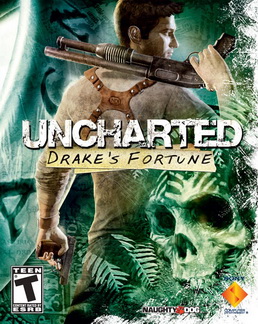
So apparently David Russell, the set writer/director of the upcoming film adaptation of Naughty Dog's Uncharted games, has left the project.  This is reportedly due to "creative differences on the project."  I assume that's the nice way of saying, "Sony wanted an actual adaptation of Uncharted, not just a movie named after it."

For those not in the loop, Uncharted is a series of games (soon to be a trilogy) exclusive to the PS3.  They are developed my Naughty Dog, the previous creator of the Crash Bandicoot and Jak and Daxter games (the good Crash games, not the recent ones).  The series follows the adventures of Nathan Drake, a treasure hunter who believes himself to be a descendant of the explorer Sir Francis Drake, as he searches for ancient treasures and protects them from being delivered into the wrong hands.  Essentially, the series is a very well-produced, technologically and artistically impressive interactive equivalent to Indiana Jones.  And it's awesome.  I know some people don't like it, but each title has been well-received critically and commercially, and the series is one of my personal reasons for owning a PS3 (the others are Heavy Rain and Metal Gear Solid 4; other than that it's basically just my Blu-ray player).

So naturally, I'm actually happy about this.  It means if we get an Uncharted movie, it may actually be a movie based on Uncharted.  When I heard about how Russell envisioned the film as similar to The Sopranos, saying it's about "a crime family that metes out justice in the world of art and antiquities," I wasn't particularly happy.  Because that's not what the game is about at all.  That is, as most game-to-movie adaptations tend to be, some guy making up his own story and using the profitable name of a video game.  That's not okay, I'm tired of it, and I hope whoever picks it up actually respects the source material. I know Russell said he enjoys playing it and has respect for it, but he followed that by saying he had to create "another amazing world that's more cinematic."  That should be a huge red flag for any adaptation of anything, but for these games, out of all games, that statement simply is not valid (particularly the word "cinematic").  If you've played them you know what I mean.  


He should be Drake, gorramit!
It also looks like Mark Wahlberg will be reconsidered as well, which I am happy about because, as much as I'm sure he would do well, I'm glad Nathan Fillion may get another chance at a role he simply belongs in.  Yes, I admit to being an avid Nathan Fillion fan, I like pretty much everything he's been in, and Drake looks very similar to him (though perhaps a bit younger), not to mention Nolan North (Drake's voice actor) sounds almost exactly like Fillion.  

Game-to-film adaptation (adaptation in general, for that matter) is a complex issue; you can bet a full article will be coming on the subject at some point, and there will be much to discuss.

In other news, the delay of both The Last Guardian and the high definition Ico/Shadow of the Colossus Collection gives me sad, but I look forward to the resulting more highly-polished final products.  That said, I will be listening to the Shadow of the Colossus soundtrack constantly until I can finally play one of the most epic games ever made in HD.